
Mistral’s self-hosted worker can still store sessions with Mistral
European ownership earns a shortlist. Working deployments, capable operators and customers willing to renew…

The short version
- European cloud providers should earn purchases through working application trials, operational readiness and credible exits, not ownership alone.
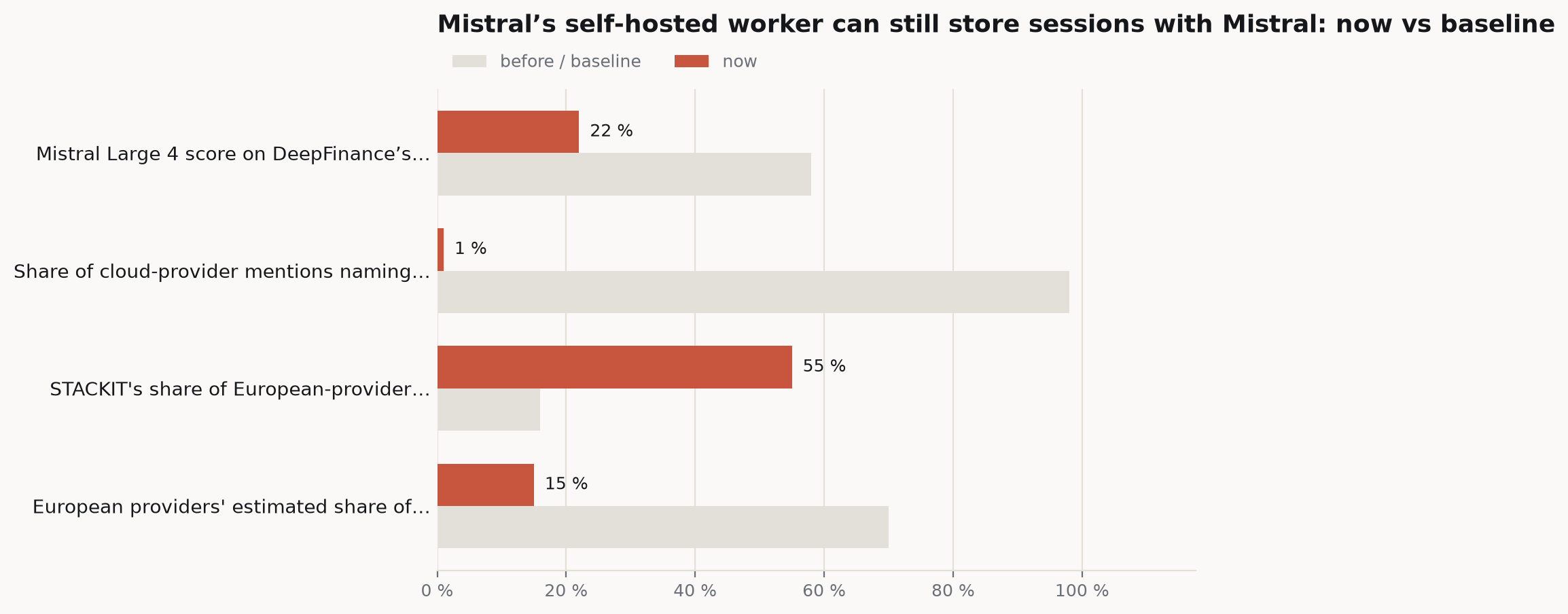
- European providers held about 15% of Europe’s cloud market in 2025, versus roughly 70% for Amazon, Google and Microsoft combined.
- Buyers should budget training, test failure recovery and track repeat purchases to distinguish usable infrastructure from promising announcements.
European cloud providers need a better audition
I want Europe to buy European, and the supplier to survive the technical interview. Patriotism gets IONOS or STACKIT shortlisted; it cannot debug a failed deployment.
I’m an Italian founder in America, European down to my unreasonable coffee opinions. I want a more integrated EU helping its AI companies win customers and earn their loyalty.
EPIS cites Synergy Research Group’s 2025 estimates: European providers held about 15% of Europe’s cloud market, versus roughly 70% for Amazon, Google and Microsoft combined. I’d use coordinated European purchasing power to close that gap.
Give buyers something testable, someone to operate it and a credible exit. A reassuring badge can hide expensive homework.
I want to trace one request through the application
I compare European cloud providers against an application I need to run. Catalogues come afterwards, preferably before the slide about “unlocking potential.”
By digital sovereignty, I mean the practical ability to make and enforce infrastructure and data decisions. European ownership matters. So does knowing where dependencies lead.
I’d trace a request from login to stored result. Authentication controls entry; the application needs its database and paid-for AI function. Deployment tools must create those resources with appropriate permissions; monitoring must catch failures before customers do. Without a managed service I already use, my team inherits its replacement, changing operating costs and hiring needs. I compare complete applications, listing every customer-operated component.
Mistral Studio shows why, even with suppliers I like. DataStudios and Shubham Sharma report that self-hosted agents serve runs the worker on customer infrastructure but stores sessions with Mistral. Fully customer-hosted Studio is a separate arrangement.
The self-hosted label is defensible: the worker runs on customer machines. That’s useful, but doesn’t satisfy a requirement to keep session data inside my network. Before approval, I need routing and storage checked for that exact deployment.
Reports also disagree on when some new Studio capabilities reach private infrastructure. Available primary excerpts leave the feature-by-feature timetable unresolved. Show me the feature running in the proposed environment.
My comparison sheet gives IONOS, OVHcloud and STACKIT separate columns. For each required capability: provider-supplied, team-operated or unavailable. Documentation earns a provisional entry; a working trial earns the purchase.
The EU AI Act risk level assessment belongs alongside that sheet, not in the hosting column. A European hosting address alone says nothing about my application’s risk classification.
I’m excited about photonics. I still want the stopwatch
The IONOS and Q.ANT pilot is European industrial ambition I want funded: unusual hardware customers can test on their own problems.
Their November 9, 2026 announcement offers selected participants access to a Q.ANT photonic processor in an IONOS data centre in Germany.
IONOS chief executive Achim Weiss made the case in that announcement:
Promising computing technologies from Europe need sovereign European infrastructure to make the leap into business use.
Applicants need a concrete use case and the ability to administer a bare-metal server independently. Approved participants access the processor using their own software and data. It performs complex nonlinear functions directly with light, rather than sequences of digital operations. Q.ANT reviews workloads and results with participants; IONOS supports server infrastructure. The programme tests which applications benefit, making customers’ workloads part of the experiment. I like an admission requirement that amounts to: bring a worthwhile problem.
My stopwatch runs from prepared input to usable result, holding output quality constant. I also want total server energy and the service’s operating cost outside a pilot.
The announcements publish no participant results comparing end-to-end performance or energy use against digital alternatives at equivalent output quality. Those cells stay empty.
My own measurements remind me to keep performance claims narrow. In our local tests, gpt-oss:20b generated about 74 tokens per second versus about 51 for gpt-oss:120b. Both stayed fully resident in memory.
We tested them on an M3 Max with 128GB of memory on August 25, 2026, not cloud infrastructure. Claiming equivalent cloud throughput would require another test.
The same setup’s RTX 5060 Ti handles image generation; the language workload falls back to CPU when ComfyUI occupies GPU memory. In our test, Ollama ran the language model entirely on CPU despite the accelerator’s physical presence. Before counting GPU capacity, I had to check what already occupied it.

I need someone who can operate the thing
When I want a European supplier to win, I’m susceptible to counting my learning time as free. Founder accounting has several exciting fictional genres.
Projectmatch’s German IT-listings study suggests charging those hours properly. From May through October 2026, about 1% of cloud-provider mentions named European providers, versus 98% naming US providers.
An AI model read the descriptions; listings naming several providers counted for each. These are mentions, not cloud revenue or available engineers. An experienced internal team could change a buyer’s situation completely.
I see a plausible feedback loop, not proved by the study. Deployments motivate engineers to learn a platform, including permission failures and awkward upgrades. Buyers can hire people who have already made expensive mistakes, lowering the effort of their next deployment. More customers create more reasons to learn. Smaller providers must help buyers bridge that experience gap even when their software meets requirements.
My trial needs a named deployment lead, incident support and an explicit training budget, followed by a controlled failure for the proposed operator to diagnose. Who answers when the application goes down?
Infrastructure needs failure testing too. AWS reports switching off its global backbone and operational-data transfer system during an exercise. Traffic rerouted over the public internet while workloads continued.
That demonstrates operational independence under those exercise conditions. AWS still owns it. The test leaves open how its sovereign cloud would handle a longer disruption or legal demand. One success cannot settle either.
Eurelectric’s November 3, 2026 position offers the strongest practical objection to broad geographic sovereignty requirements: they could restrict access to cloud-hosted grid tools or raise costs where comparable compliant services remain unproven at scale.
I take that seriously. Grid operators have obligations my enthusiasm cannot fulfil. Preferring European ownership doesn’t justify demanding an unsafe migration. I’d fund staged trials and reliability checks, keeping suitable existing services available during transition. Eurelectric’s warning is a policy assessment; the available material quantifies neither effect’s magnitude.
I want Brussels to help place the second order
The German school-cloud framework interests me because procurement can turn European ambition into an ordinary purchase.
Govdigital’s competition produced an IONOS framework contract for a Nextcloud-based workspace. Schools in Berlin, Bremen, Hamburg, Hesse, North Rhine-Westphalia and Rhineland-Palatinate can choose it. Adoption is optional.
In Nextcloud’s November 3, 2026 announcement, founder Frank Karlitschek explained why schools need this alternative:
Schools should teach digital skills, not dependency on individual technology providers.
I agree, and want purchasing arrangements that make it practical. A shared competition saves eligible institutions repeated procurement work and gives suppliers a route to customers with related needs. Deployments expose recurring support problems, helping operators improve subsequent migrations. Later buyers gain references from familiar institutions. But schools must choose and use the service; eligibility alone produces little operating experience.
The announcement reports neither whether schools will adopt the workspace nor at what scale. My scorecard would distinguish active users from institutions eligible to buy.
The Bull and Schwarz Digits memorandum is another early purchasing-stage effort. Their proposed cooperation combines Bull’s server and AI expertise with STACKIT infrastructure. I welcome the Franco-German effort, but proposed server and marketplace initiatives remain plans. The memorandum establishes neither deployed products nor measurable customer adoption.
As a federalist, I want the EU to make these efforts easier to evaluate across borders. Ministries should reuse other countries’ test methods and inspect their deployment experience. Making every national procurement team rediscover the same failure is an expensive way to preserve our differences.
The Data Act’s switching rules reduce specified contractual and fee barriers. EPIS argues European providers also need competitive services, effective procurement and enforcement to win customers. I agree: cheaper exits still need suitable destinations. Switching rights create no capacity themselves.
My proposed EU purchasing programme starts with a common workload and evaluation method published before suppliers compete. Buyers record deployment effort and reliability, then publish whether they ordered again. Meaningful purchase commitments would give successful suppliers something firmer than applause for capacity planning.
The programme needs room for revision. Available sources establish neither the proposed EU cloud-sovereignty framework’s eventual legal text nor its measured impact. Procurement teams should work from existing requirements, clearly distinguished from proposals whose final form remains unknown.
By November 2027, I predict the school framework will offer a more persuasive reference through a completed renewal than Bull and Schwarz Digits through their memorandum alone. I’d happily be proved wrong by a deployed product with a paying customer.
But I want the next headteacher to ask a colleague, “Would you renew?” and get an answer from someone who has already signed.
Frequently asked questions
How should buyers compare European cloud providers?
Buyers should compare European cloud providers against a complete application, tracing authentication, databases, AI functions, deployment permissions and monitoring. Each required capability should be marked as provider-supplied, team-operated or unavailable. A working trial should verify deployment effort, operational support, failure recovery and a credible exit before purchase.
Does European cloud hosting determine an application’s EU AI Act risk level?
A European hosting address alone does not determine an application’s EU AI Act risk level. Risk classification belongs in a separate assessment alongside the infrastructure comparison. European ownership and deployment location are relevant to sovereignty decisions, but they do not establish the application’s regulatory risk classification.
What does the IONOS and Q.ANT photonic computing pilot demonstrate?
The IONOS and Q.ANT pilot offers selected participants access to a photonic processor in Germany to test their own workloads. The announcements publish no participant results comparing end-to-end performance or energy use with digital alternatives at equivalent output quality, so comparative performance benefits remain unestablished.
Sources
- European cloud providers in German IT contracts: STACKIT leads – far behind AWS and Azure
- IONOS and Q.ANT Launch Photonic Computing Pilot
- Six German states gain access to sovereign school cloud based on Nextcloud
- Bull and Schwarz Digits: a Franco-German alliance for Europe’s digital sovereignty
- Who controls your cloud? A conversation with Telia’s Chief Architect
- Sovereign Cloud: European and global innovation, controlled by Europe